Inside Aireal: how we map a neighborhood in 90 seconds
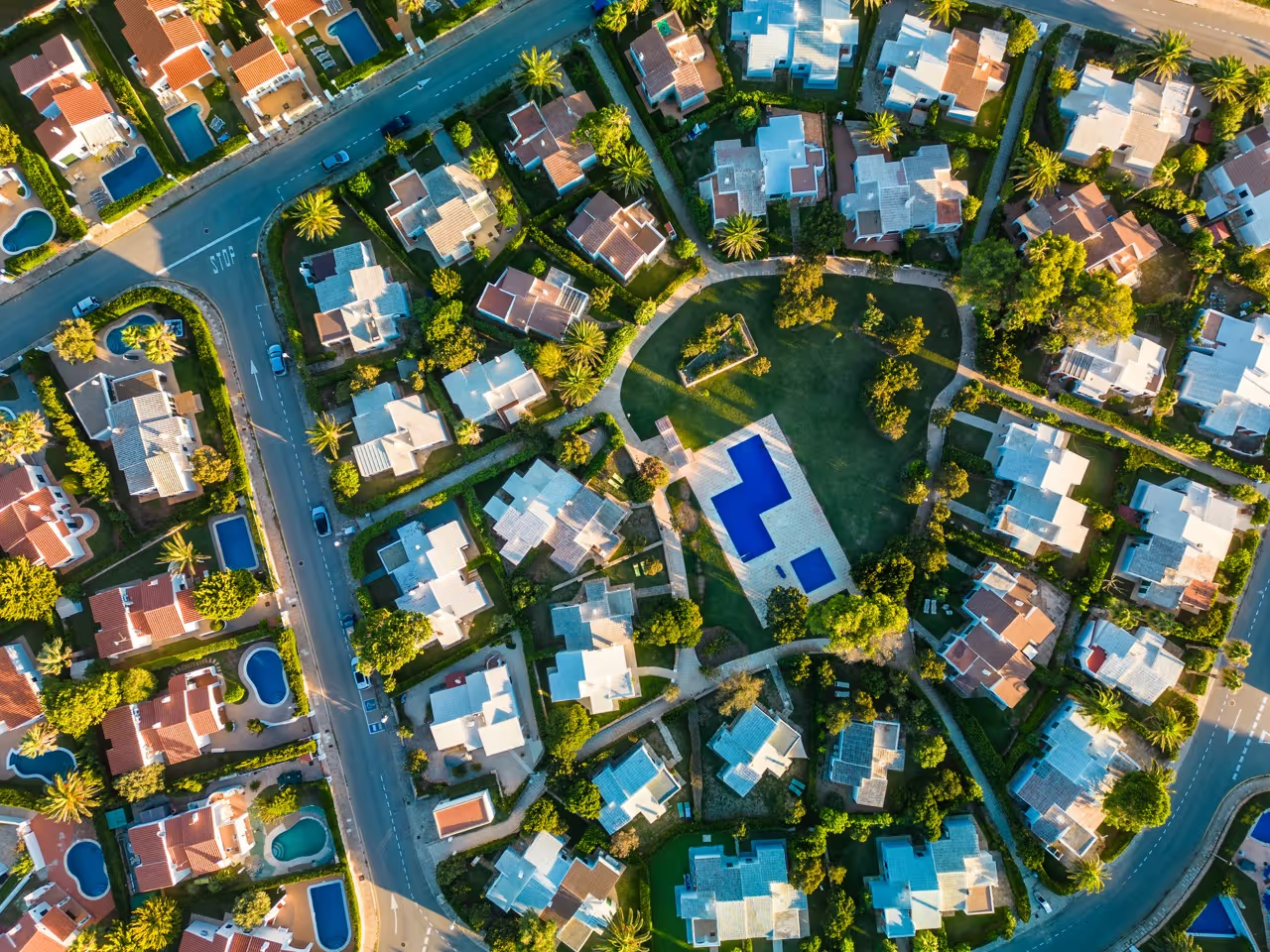
When we tell people Aireal maps a full neighborhood in 90 seconds, the first reaction is usually “how?” The second is usually “why does it matter?” Both are good questions. Here's the inside view.
Neighborhood mapping used to be a project. A really specific project. You'd hire a GIS consultant, scope the area, request data from a half-dozen sources, wait for spreadsheets, clean the spreadsheets, normalize them, layer them in software that cost more than your laptop, and hope nothing in any of the source systems changed before you finished. Three weeks, $40,000 minimum, and a deliverable that was stale before it was emailed.
We thought there was a better way to do it. Not just faster — actually faster, like by orders of magnitude. So we built one. The current Aireal mapping pipeline turns a coordinate input into a fully rendered, queryable neighborhood model in 90 seconds. This post is about how, and why we chose the constraints we did.
The pipeline
Step one is ingestion. The moment a coordinate hits our API, Aireal kicks off parallel pulls across 18 data sources — public records, parcel data, permit history, school zoning, environmental layers, sale history, walkability scores, foot traffic patterns, transit data, retail density, and a few proprietary signals we won't bore you with. Each pull is independently retryable, independently cacheable, and bounded to under 15 seconds. The slowest one sets the floor.
Step two is normalization. Different sources use different coordinate systems, different precision, different categorical schemas, and frankly different definitions of what counts as a “neighborhood.” Our normalization layer reconciles all of this against a canonical schema we've been refining since 2023. Most of the engineering effort behind 90-second mapping isn't in the data fetching — it's in the cleanup.
Step three is synthesis. Raw data isn't useful to a real estate professional. What's useful is interpretation: “this neighborhood is appreciating 11% faster than its metro,” “this school district is transitioning,” “this corner has noise patterns consistent with a flight path.” Our synthesis layer turns the cleaned data into the kind of statements an agent or investor can actually act on.
Edge cases
The 90-second number is the median. The interesting question is the tail. Brand-new construction in a neighborhood that didn't have a name two years ago? Adds about 12 seconds. Rural properties where the public records exist but haven't been digitized? We pull the closest comparable and flag the gap. Properties in jurisdictions that don't publish permit data? We fall back to satellite-derived activity signals and flag confidence levels accordingly.
The harder edge cases are conceptual. “Neighborhood” is fundamentally a contested label. A buyer might think of a six-block radius. A seller might think of a school catchment. A planner might think of a census tract. Aireal renders all three, lets the user pick the lens, and explains what changes between them. This is the part that took the longest to build and is the easiest to take for granted once it works.
Where this scales
90 seconds per neighborhood is fast enough that we don't really worry about latency anymore. What matters now is coverage. We're at 94% U.S. residential coverage as of this month, with international expansion (Canada first, then UK) on the roadmap for late 2026. The goal isn't to be fast for one neighborhood — it's to be fast for any neighborhood, anywhere.
If you're curious what your market looks like through Aireal's lens, the product team would love to show you. The 90 seconds is the easy part. What's interesting is what you do with the next 90 seconds after that — which, in our experience, is when most real estate professionals stop asking how it works and start asking what else it can do.